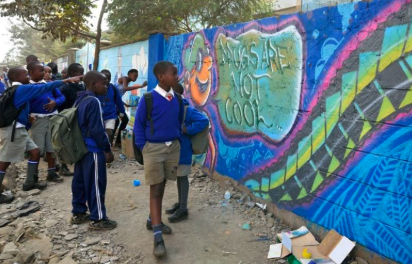
Drawing on Henri Lefebvre’s right to the city (Purcell, 2016) and Walter Mignolo’s local histories/global designs (Mignolo, 2012), this essay argues that Nairobi’s graffiti scene, produced collectively by artists and communities on public walls, constitutes a knowledge infrastructure within art history itself, rather than an alternative to it. Against the backdrop of a Western gaze that has historically determined what counts as legitimate and authentic African art, Nairobi’s graffiti, through its political and commercial register, exercises its right to the city. Using articulations of the everyday, satirical depictions of corrupt politicians or campaigns for social advocacy, Nairobi’s graffiti demonstrates that the capacity to establish aesthetic logics has never been exclusively Western (Halliday, 2024). In Nairobi, as in other cities, the city wall is a legitimate site of art-historical production, equal to any art gallery.
My interest in this work is rooted in prior research on Nairobi's public spaces — libraries, archives, museums, and gardens — and the ways their colonial legacies continue to sustain infrastructures of exclusion for the city's citizens. Of equal concern is how Nairobians persistently reclaim these spaces and transform them in ways that delink from established colonial epistemologies, producing knowledge from the periphery rather than the centre (Mutonga and Okune, 2021). This paper is organised into three sections. The first offers a brief history of Western perceptions of African art, graffiti in Africa, and Nairobi's street art scene. The second turns to four analytical questions, addressed through artefacts and critical commentary. The paper concludes with a provocation: when the wall becomes a knowledge infrastructure, what does the gallery become?

Syokau Mutonga. 26 July 2024, "Walls that Re-Member: Nairobi's Graffiti as Knowledge Infrastructure", Research Data Share, Platform for Experimental Collaborative Ethnography, last modified 8 April 2026, accessed 20 October 2026. https://www.researchdatashare.org/content/walls-re-member-nairobis-graffiti-knowledge-infrastructure