Under Construction - Completion Expected April 15, 2026
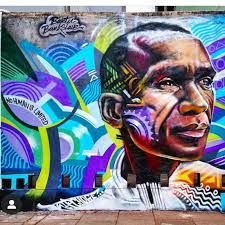
Drawing on Henri Lefebvre’s right to the city (Purcell, 2016) and Walter Mignolo’s local histories/global designs (Mignolo, 2012), this paper argues that Nairobi’s graffiti scene, produced collectively by artists and communities on public walls, constitutes a knowledge infrastructure within art history itself, rather than an alternative to it. Against the backdrop of a Western gaze that has historically determined what counts as legitimate and authentic African art, Nairobi’s graffiti, through its political and commercial register, exercises its right to the city. Using articulations of the everyday, satirical depictions of corrupt politicians or campaigns for social advocacy, Nairobi’s graffiti demonstrates that the capacity to establish aesthetic logics has never been exclusively Western (Halliday, 2024). In Nairobi, as in other cities, the city wall is a legitimate site of art-historical production, equal to any art gallery.
My interest in this work is rooted in prior research on Nairobi's public spaces — libraries, archives, museums, and gardens — and the ways their colonial legacies continue to sustain infrastructures of exclusion for the city's citizens. Of equal concern is how Nairobians persistently reclaim these spaces and transform them in ways that delink from established colonial epistemologies, producing knowledge from the periphery rather than the centre (Mutonga and Okune, 2021). This paper is organised into three sections. The first offers a brief history of Western perceptions of African art, graffiti in Africa, and Nairobi's street art scene. The second turns to four analytical questions, addressed through artefacts and critical commentary. The paper concludes with a provocation: when the wall becomes a knowledge infrastructure, what does the gallery become?
To make this argument, a brief commentary on how art history’s perceptions of African art developed is required. As colonisation was spreading across Africa in the nineteenth and early twentieth centuries, European explorers, colonisers and traders collected African stools, masks, door panels, textiles and many other quotidian objects as fascinating curiosities, often overlooking their aesthetic, cultural and spiritual significance. This was a time when Europeans were fascinated by non-Western cultures (then referred to as 'primitive') as an antidote to modernity (Kasfir, 2020). African cultures and their expression through art were collected as a form of nostalgia for an imagined ‘state of nature’ when humanity was assumed to have lived in closer harmony with the natural and spiritual worlds. Subsequently, African artworks were collected for their authenticity - made in a recognised, unique style by African artists for African patrons. Anything made for commercial gain was considered inauthentic art in Western terms. In this way, the colonial project determined what counted as African art or craft and what was authentic or inauthentic. The consequences of this persist to the present, determining which African art forms and artists thrive in the global contemporary art market and which don’t. Any argument about African art as knowledge infrastructure must begin here. Furthermore, African contemporary arts did not emerge suddenly toward the end of the 20th century. Instead, they were built through bricolage, with new articulations merging with older colonial and precolonial African art genres. In many cases, new articulations of African art emerged and continue to materialise in cities and regions where they did not have to compete with an already existing tradition. Some of these cities where new articulations have emerged are Nairobi, Harare, Johannesburg, Addis Ababa, Dakar, and Entebbe. Art from these cities is creating new forms of contemporary African art (Kasfir, 2020). Graffiti is one such articulation — and among the most politically charged.
Graffiti emerged as a contemporary art form in Africa at the beginning of the twenty-first century. Described as a form of artivism that blends art and activism, graffiti has been shaped by the interplay of local tastes, traditions, socio-political contexts, and global influences. It has grown in popularity as a medium for political activism, with city walls reclaimed through art as a global social intervention (Aladro-Vico et al., 2018). Graffiti artists across Africa have used their art to dissent against the status quo, particularly during significant political events. Some of these included the 2010/11 Arab Uprisings in North Africa and the 2018/19 revolution in Khartoum, Sudan. In South Africa, graffiti was utilised to oppose apartheid regimes and more recent movements like #RhodesMustFall (Halliday, 2024). Graffiti artists also use it to foster community engagement and education, especially among the youth. For example, in Senegal, it has connected the youth to a movement to cleanse and beautify urban spaces. It is a broad canvas that artists use to challenge societal norms and engage in broader dialogues about who owns the city.
In Nairobi, graffiti has evolved since its inception. Its roots lie in the emergence of privately owned minibuses in the late 1950s and 1960s. These minibuses, popularly known as matatus, fostered a culture of artistic expression. By the 1980s and 1990s, matatu culture had absorbed hip-hop aesthetics, louder sound systems, and bolder graphics, laying the cultural groundwork for a distinctly Nairobian visual language. In doing so, it cultivated the audience and the artists that a publication like WaPI would later bring into focus. WaPI (Words and Pictures) was launched in 2006 with support from the British Council. It was published monthly and celebrated Nairobi’s hip-hop culture and emerging graffiti artists. The talents of some of Nairobi’s famous graffiti artists, such as Uhuru Brown, Smokillah, Swift, and Spray Uzi, were showcased at WaPI (Halliday, 2024). What began on the sides of minibuses has grown into a chorus of producers, artists, community members, and street walls — a scene whose full significance becomes visible only when examined on its own terms.
The late Professor Ali Mazrui believed that politics was no place for the artist: "No great artist has a right to carry patriotism to the extent of destroying his creative potential" (James, 2025). Nairobi's artists have answered that provocation differently. Whether through Nganya art that laid the groundwork for future articulations of public expression, murals that protest corruption, commercial commissions that celebrate Kenya's rich artistic culture, or community projects that seek to reinvigorate amidst dispossession, they have never waited for permission — from the state, from institutions, or from art history itself.
That refusal is the argument. When the wall becomes a knowledge infrastructure, new ways of being in the world become possible, beyond the colonial, Western determination of what counts as art and who gets to make it. In Nairobi, it always has.
Aladro-Vico, E., Jivkova-Semova, D., & Bailey, O. (2018). Artivism: A new educative language for transformative social action. Comunicar, 57, 9–18. https://doi.org/10.3916/C57-2018-01
Chonghaile, C. N. (2012). Kenyan Graffiti Artists Step up Battle Against ‘Vulture’ Politicians. The Guardian. https://www.theguardian.com/world/2012/mar/21/kenya-graffiti-artists-politicians-vultures
Fanon, F. (2004). The Wretched of the Earth. Translated by Richard Philcox. New York: Grove Press.
Halliday, C. (2016, March 8). Street art: Taking art to the people. Africanah.org. https://africanah.org/street-art-taking-art-to-the-people-2/
Halliday, C. (2019). Animating Political Protests through Artivism in 21st century Nairobi, Kenya. The Journal of Law, Social Justice & Global Development, 24. https://doi.org/10.31273/LGD.2019.2406
Halliday, C. (2024). Graffiti as a Catalyst for Urban Creativity: Exploring Agency, Participation, and the Right to the City in Nairobi. European Journal of Development Studies, 4(6), 25–37. https://doi.org/10.24018/ejdevelop.2024.4.6.391
Hartman, S. (2019). Wayward lives, beautiful experiments: Intimate histories of riotous Black girls, troublesome women, and queer radicals. W. W. Norton & Company.
James, H. (2025). How Gen Z used art culture to fuel protest in Kenya. People Daily Digital. https://peopledaily.digital/lifestyle/how-gen-z-used-art-culture-to-fuel-protest-in-kenya
Kasfir, S. L. (2020). Contemporary African art (2nd ed.). Thames and Hudson.
Kenya’s Artists Rise in 2025 Protests. (2025, June 27). Mimeta. https://www.mimeta.org/mimeta-news-on-censorship-in-art/2025/6/27/kenyas-artists-rise-in-2025-protests
Lagat, F. (2025, October 31). Matatu mania: Why Nairobi's nganya culture is therapy Gen Z won't let go of. People Daily. https://peopledaily.digital/lifestyle/matatu-mania-why-nairobis-nganya-culture-is-therapy-gen-z-wont-let-go-of
Massing, J. M., & Danimbe, J. (2025). Sensibilités vaudou dans l'art contemporain d'Afrique. Fondation Blachère.
Mignolo, W.D. (2000). Local Histories/Global Designs: Coloniality, Subaltern Knowledges, and Border Thinking.
Njugi, F., & Ogwa, T. (2024). Kenya’s Gen Z and the Art of Protest. The Elephant. https://www.theelephant.info/analysis/2024/10/18/kenyas-gen-z-and-the-art-of-protest/
Ombati, M. (2015). Public artworks: Creative Spaces for Civic and Political Behaviour in Kenya. The Australasian Review of African Studies, 36(1), 29–50. https://search.informit.org/doi/10.3316/informit.161626523109358
Purcell, M. (2016). Possible Worlds: Henri Lefebvre and the Right to the City. Journal of Urban Affairs, 36(1), 141–154. https://doi.org/10.1111/juaf.12034
Stickells, L. (2011). The right to the city: Rethinking architecture's social significance. Architectural Theory Review, 16(3), 213–227. https://doi.org/10.1080/13264826.2011.628633